Total Pageviews

Showing posts with label Hematology. Show all posts

Saturday, 30 June 2012

POEMS syndrome

- rare multisystem disease that occurs in the setting of plasma cell dyscrasia
- P - polyneuropathy (symmetrical and distal)
  O - organomegaly (liver, spleen and lymph nodes)
  E - endocrinopathy
  M - monoclonal gammopathy
  S - skin abnormalities (hyperpigmentation and hypertrichosis)

Thursday, 7 June 2012

von Willebrand disease

- most common inherited bleeding disorder
- VWF serves two roles
  i) major adhesion molecule that tethers the platelet to exposed subendothelium
  ii) binding protein for FVIII
- males and females are equally affected but disease manifestation is more obvious in female due to menstruation and associated menorrhagia
- screening test are PT, APTT, factor VIII activity, vWF activity and vWF antigen level determination
- ristocetin is an antibiotic that causes vWF to bind to and activate platelet causing platelet agglutination. Degree of platelet agglutination is proportional to concentration of plasma vWF


Friday, 18 May 2012

Paroxysmal cold hemoglobinuria

- rare form of AIHA occuring mostly in children
- usually triggered by a viral infection, usually self limited
- characterised by the involvement of Donath-Landsteiner antibody
- in vitro, this antibody has unique serologic feature: it has anti-P specificity and it binds to red cells only at low temperature (optimally at 4°C). When temperature is shifted to 37°C, lysis of red cells take place in the presence of complement
- consequently, in vivo there is intravascular hemolysis resulting in hemoglobinuria
- also presents with rigor and bone pain
- supportive treatment inlcuding blood transfusion is needed to control the anemia

Sunday, 13 May 2012

acquired hemophilia

- FVIII is the most common target of antibody formation against specific clotting factor
- occurs predominantly in older adults (median age of 60)
- 50% idiopathic, others are associated with autoimmune disease, malignancy and pregnancy
- bleeding episodes occur commonly in soft tissues, GI or urinary tracts, haemarthrosis is rare
- prolonged APTT with normal PT
- Bethesda assay using FVIII deficient plasma as performed for inhibitor detection will confirm the diagnosis
- treatment with factor VIII is ineffective as the inhibitor has rapid activity
- bleeding is treated with recombinant activated factor VII or FEIBA(factor eight bypassing agent)

Sunday, 6 May 2012

Chronic lymphocytic leukemia (CLL)

- accumulation of mature B cells that have escaped apoptosis and undergone cell cycle arrest in the G0/G1 phase
- commonest leukemia
- often asymptomatic, incidentally diagnoses on routine FBC
- may be anemia, infection prone, weight loss, night sweats and anorexia
- blood smear : smudge cells
- complications includes AIHA, frequent infections (hypogammaglobulinemia) and marrow failure
- death is often due to infections (pneumococcus, haemophilus, meningococcus, candida or aspergillosis) or transformation to aggressive lymphoma (Richter's syndrome)
- if asymptomatic - periodic follow up
- indications for chemotherapy (Fludarabine) * to give with co-trimoxazole for PCP prophylaxis
   ~ night sweats, fever, rapid weight loss, progressive marrow failure, symptomatic splenomegaly
- supportive care (transfusion or IVIG if recurrent infections), steroids for AIHA
- positivity to ZAP (zeta associated protein) 70 is associated with poorer prognosis


Sunday, 26 February 2012

Multiple myeloma

- represents a malignant proliferation of plasma cells derived from a single clone
- incidence increases with age, median age at diagnosis is 70 years
- males are more commonly affected than females
- classic triad of myeloma is marrow plasmacytosis (>10%), lytic bone lesions and serum and/or urine M component

Clinical manifestations
- bone pain is the most common symptom in myeloma (70%), which usually involves the back and ribs. The pain of myeloma is precipitated by movement, unlike pain of metastatic carcinoma which usually worse at night. Osteoclastic activity is mediated by osteoclast activating factors made by myeloma cells
- susceptibility to bacterial infections (usually pneumonias and pyelonephritis) caused by hypogammaglobulinaemia. 
- renal failure (most commonly caused by hypercalcemia. Other causes are glomerular deposits of amyloid, hyperuricemia, tubular damage by light chains, frequent use of NSAIDs, infiltration of kidney by myeloma cells, use of iodinated contrast dye for imaging). Earliest manifestation of tubular damage is adult Fanconi syndrome
- normochromic normocytic anaemia caused by replacement of normal marrow by expanding tumor cells, inhibition of hematopoiesis by factors made by tumor and reduced production of erythropoeitin by kidney
- hyperviscosity may developed depending on physical properties of M component (most common with IgM, IgG3 and IgA paraprotein)

Diagnosis
- important differential diagnosis are MGUS (serum M protein <30g/L and bone marrow clonal plasma cells <10%) and asymptomatic/smoldering myeloma
- Investigations
i) Chest and bone radiographs - lytic lesions or diffuse osteopenia
ii) Full blood picture- anemia and Rouleux formation
iii) ESR - elevated
iv) serum calcium, urea nitrogen, creatinine and uric acid levels may be elevated
v) serum and urine protein electrophoresis - characteristic M spikes
vi) 24-h urine specimen to quantiate Bence Jones protein excretion
vii) serum B2-microglobulin (single most powerful predictor of survival)


Treatment
- 10% of patients with indolent/smoldering myeloma only require antitumor therapy when the disease becomes symptomatic
- supportive care directed at the anticipated complications (bisphosphonates, steroid, hydration for hypercalcemia; plasmapheresis for acute renal failure and hyperviscosity syndrome)
- Bortezomib (proteasome inhibitor) and lenalidomide combined with dexamethasone obtained high response rate (>80%) without compromising stem cell collection for transplantation
- For patients not transplant candidate, therapy consisting of intermittent pulses of an alkylating agent, melphalan with prednisolone
- radiotherapy is effective for bony lesions
- Median survival is 7-8 years. Major causes of death are progressive myeloma, renal failure, sepsis, or therapy-related myelodysplasia

Sunday, 25 December 2011

Antiphospholipid syndrome

- a.k.a Hughes syndrome
- characterised by recurrent venous/arterial thrombosis and miscarriages
- anticardiolipin antibodies and lupus anticoagulant positive
- paradoxical prolongation of APTT (due to antibody interfering the test), false positive syphilis test
- can cause hypoadrenalism (adrenal vein thrombosis)
- other features: migraine headache, chorea, seizures, transverse myelitis, GBS, livedo reticularis
- aspirin (if wish to get pregnant) or warfarin for patient with thrombotic syndromes

Saturday, 24 December 2011

Sickle cell disease

- Hemoglobinopathy caused by substitution of glutamic acid by valine at position 6 (from N terminal) of beta chain
- autosomal recessive
- 2 forms : heterozygous (HbAS) and homozygous (HbSS)
- low partial pressure of oxygen causes HbS to polymerise and precipitate, resulting sickling of erythrocytes.
- HbSS sickle at PO2 of 6kPa and HbAS/HbSC sickle at 4kPa
- Exchange transfusion is indicated when there is neurological damage or visceral sequestration crisis in sickle cell crisis
- most common cause of aplastic crisis is parvovirus infection
- salmonella osteomyelitis is seen in patient with sickle cell anemia
- Sickledex test involves the addition of reagent to blood, turbidity confirms the presence of HbS

Target cells and Howell Jolly bodies


- Target cells are red cells with central staining with precipitated haemoglobin seen in conditions with abnormal haemoglobin as well as cell membrane
- Causes are target cells : sickle cell disease, thalassemia, iron deficiency anemia, liver disease

- Howell Jolly bodies contain nuclear remnants
- Causes: post-splenectomy, leukemia, megaloblastic anemia, iron deficiency anemia

Tuesday, 20 December 2011

Polycythemia rubra vera

- Primary polycythemia is a clonal stem disorder in which there is excessive proliferation of erythroid, myeloid and megakaryocytic progenitor cells
- over 95% patients with PV have acquired mutations of the gene Janus Kinase 2 (JAK2)
- presents with lethargy, depression, vertigo, itching, gout and visual disturbance
- ruddy cyanosis, plethoric conjunctiva, hypertension, hepatosplenomegaly
- Hb, PCV and RCV are increased
- increased NAP score
- 30% develops myelofibrosis and 5% develop AML
- major complication is bleeding and thrombosis
- treatment: venesection (400-500ml per week, aim PCV < 0.45) or hydroxyurea, H2 receptor antagonist for itchiness, low dose aspirin to prevent thrombosis

Sunday, 27 November 2011

Methaemoglobinaemia

- caused by either genetic defect in red cell metabolism or haemoglobin structure or acquired by a variety of drugs and toxins
- results from oxidation of ferrous iron in haemoglobin to ferric form
- oxygen-hemoglobin dissociation curve shifts to left
- causing precipitation as Heinz bodies and eventually leads to hemolytic anemia
- common drugs: dapsone, nitrates, antimalarials, sulphonamides and dyes
- presents with cyanosis, SOB, mental status change, headache, dizziness, arrhythmias, seizures
- chocolate brown blood
- low SaO2 (on oximeter) but good PO2 (ABG)
- treatment: methylene blue 1-2mg/kg and oxygen, ascorbic acid as second line drug

Wednesday, 23 November 2011

Graft versus host disease

- common complication after stem cell or bone marrow transplantation
- donor cells against normal host organs
- Billingham criteria - 3 criteria must be met in order for GVHD to occur
  i) immunocompetent graft is administered with viable and functional immune cells
  ii) recipient is immunologically disparate - histo-incompatible
  iii) recipient is immunocompromised, therefore cannot inactivate or destroy the transplanted cells
- can be divided into acute (within first 100 days post-transplantation) or chronic
- onset of acute GVHD is usually from day 16 - day 20 as donor marrow engrafts and the neutrophils count rises
- acute GVHD causes a skin rash (typically commencing on palms and soles), diarrhea and jaundice
- more common after unrelated donor transplantation
- initial treatment of acute GVHD is high dose methylprednisolone. If no response, consider antilymphocyte globulin

Saturday, 12 November 2011

Hairy cell leukemia

- rare leukemia, 2% of lymphoid leukemia
- male:female = 4:1
- hairy cells are larger than lymphocytes, their nuclei show a homogenous loose chromatic pattern without a visible nucleolus and cells have abundant cytoplasm with broad base projection or villi, nuclear outline is often kidney shape
- presents with pancytopenia and massive splenomegaly
- associated with monocytopenia (typical finding)
- skin vasculitis (erythema nodosum & cutaneous nodules) in one third of patients
- bone marrow trephine biopsy: characteristic clear zone between cell (fried egg appearance)
- increased bone marrow reticulin often results in dry tap marrow aspirate despite marrow hypercellularity
- abnormal cells are strongly positive for tartrate resistant acid phosphatase strain (TRAP)
- respond dramatically to purine analogues (cladribine and pentostatin), with survival rate at 5 years
of 95-95%

Sunday, 6 November 2011

Cryoglobulinemia

- cryoglobulins are immunoglobulins and complement components which precipitate reversibly in cold, which leads to small vessel damage and deposition on the wall of small vessel result in generalised vasculitis
- presents with purpura, arthralgia, leg ulcers, Raynaud's phenomenon, polyneuropathy, asymptomatic proteinuria, microscopic hematuria or nephrotic syndrome
- skin most commonly involved (>90%) - reticulated skin pattern of microthrombosis and areas of gangrene
- management : plasma exchange, high dose steroid, chemotherapy (cyclophosphamide) and treatment of underlying conditions
- 3 types are recognised

Type I
- monoclonal antibody (usually IgM)
- associated with multiple myeloma and lymphoproliferative disorder
- presents with acrocyanosis, Raynaud's phenomenon, retinal hemorrhage

Type II & III (mixed cryoglobulinemia)
- IgM or IgA with rheumatoid factor activity binds to polyclonal IgG
- type II is monoclonal ; whereas type III is polyclonal
- presents with glomerulonephritis (more common in type II), vasculitic rash and Raynaud's
- they can activate the classical pathway of complement and cause consumption therefore low C4 with normal C3
- associations: Hepatitis B and C, HIV, CMV, malaria, EBV, malaria, autoimmune disorder
  * Meltzer's triad =  Purpura + Arthralgia + Myalgia *
     (Typically seen in polyclonal CG - hepatitis C)

Thursday, 3 November 2011

Heparin induced thrombocytopenia

- usually occurs 5-14 days after first heparin exposure
- due to immune response directed against heparin/platelet factor 4 complexes
- paradoxially associated with severe thrombosis (most commonly DVT)
- thrombosis results from IgG-induced platelet activation (via platelet Fc receptor) which leads to generation of procoagulant, platelet derived microparticles.
- Type 1 HIT (non-immune) presents with first 2 days after exposure, platelet count normalised with continued heparin therapy (rarely falls below 100 X 10^9/L in type 1). Type 2 HIT (immune mediated) is the serious type with thrombotic complications.
- presence of anti-PF4-heparin antibodies
- alternative anticoagulation: heparinoid danaparoid or direct thrombin inhibitor hirudin
   (avoid warfarin - risk of warfarin necrosis)

Thursday, 13 October 2011

Paroxysmal nocturnal hemoglobinuria

- a.k.a Marchiafava Micheli syndrome
- somatic mutation in the phosphatidylinositol glycan-A gene on X chromosome
- aplastic anemia like syndrome in which red cells are predisposed to complement lysis causing hemolytic anemia
- deficient GPI (glycophosphatidylinositol) anchored membrane proteins (CD55, CD59)
- presents with hemoglobinuria and venous thrombosis (eg:Budd Chiari thrombosis)
- immunophenotyping : absence of CD55 (decay accelerating factor) /CD59 (membrane inhibitor or reactive lysis)
- HAM test or flow cytometric evaluation of blood is diagnostic test.
- treatment: plasma reduced washed red cells (correct anemia), warfarin, eculizumab (new monoclonal antibody which inhibit complement system)
- significant proportion of patient go on to develop aplastic anemia or acute leukemia

Wednesday, 12 October 2011

Hemochromatosis

- autosomal recessive
- commonest mutation is C282Y, in chromosome 6, affecting HFE gene
- most common single gene disorder in caucasians (carrier frequency 1 in 10)
- serum iron is elevated (>300mg/dL)
- serum transferrin saturation > 50% (most sensitive biochemical marker of iron overload)
- serum ferritin increased
- urinary iron excretion markedly increased (>2mg/24hour) by chelating drug desferioxamine
- diagnosis confirmed by DNA analysis
- presents with skin pigmentation (iron deposition stimulates increase melanin production), hepatic dysfunction, diabetes (bronze diabetes), hypogonadism, arthropathy (pseudogout), restrictive cardiomyopathy
- treatment: regular venesection (monitor by serum ferritin) - cardiomyopathy may improve with venesection

Wednesday, 5 October 2011

Hypereosinophilic syndrome

- characterised by persistently elevated eosinophil count for at least 6 months with involvement of heart, CNS and bone marrow
- eosinophil count more than 1.5X10⁹/L
- presented with weight loss, rashes, fever, peripheral neuropathy, edema, cardiac disturbance
- exclude Strongyloides stercoralis (can cause hyperinfection syndrome if given steroid)
- 2 forms of heart involvement : endomyocardial fibrosis (Davies disease), Loeffler's endocarditis
- treatment: steroid and hydroxurea

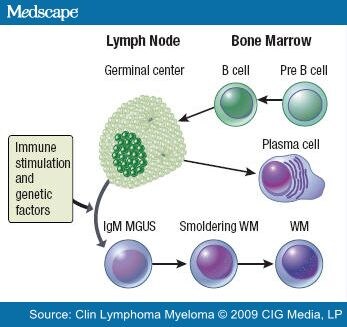
Waldenstrom macroglobulinemia

- a.k.a lymphoplasmacytoid lymphoma
- malignant plasma cell proliferative disorder
- typically presents in 7th/8th decade of life
- increased IgM paraprotein
- presented with weakness, weight loss, fatigue, hepatosplenomegaly, lymphadenopathy
- most common complication is hyperviscosity syndrome
- increased plasma volume due to large amount of paraprotein
- serum protein electrophoresis - 75% IgM are kappa
- no isotype suppression (normal IgG and IgA levels)
- bone marrow aspirate often hypocellular, but biopsy specimen often hypercellular and extensively infiltrated by lymphoid or plasmacytoid cells
- no treatment needed if asymptomatic
- treatment  : plasmapheresis (for hyperviscosity), chemotherapy (chlorambucil or fludarabine)