Total Pageviews

Saturday, 8 October 2011

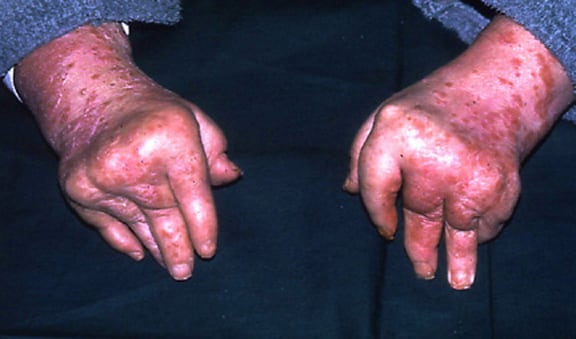
Sweet's syndrome

- a.k.a acute febrile neutrophilic dermatosis
- presents with fever and acute tender red plaques on face, neck, back or arms
- 50% have hematological disorder and peripheral neutrophilia
- papillary dermal infiltrates of neutrophils
- treatment: corticosteroid

Causes of lung fibrosis

Upper lobe fibrosis "BREAST X"

B: bronchopulmonary aspergillosis
R: radiotherapy
E: extrinsic allergic alveolitis
A: ankylosing spondylitis
S: sarcoidosis
T: tuberculosis
X: histiocytosis X

Lower lobe fibrosis "CRABSS"

C: cryptogenic fibrosing alveolitis
R: rheumatoid arthritis
A: asbestosis
B: bleomycin
S: SLE
S: scleroderma

Surgical resection of lung cancer - contraindication

Contraindications for surgical resection of lung cancer

- FEV1 less than 1.5L for lobectomy ; 2.0L for pneumectomy
- mediastinal lymph node more than 1cm
- staging more than IIIB
- recurrent laryngeal nerve involvement
- malignant pleural effusion present
- proven metastasis

Friday, 7 October 2011

IgA nephropathy (Berger's disease)

- commonest form of glomerulonephritis world wide
- focal and segmental proliferative glomerulonephritis with mesangial deposits of polymeric IgA
- associated with coeliac disease, cirrhosis and HIV infection
- IgA raised in 50% of cases
- tends to occur in children and young males, presents with asymptomatic microscopic hematuria or recurrent macroscopic hematuria following URTI/gastrointestinal viral infection (usually 1-2 days after URTI as opposed to PSGN which occur some time later) - synpharyngitic haematuria
- hypertension is associated with deteriorating renal function and thus worse prognosis
- prognosis usually good, but 25% risk of developing ESRF
- commonest primary glomerulonephritis leading to chronic renal failure
- treatment: steroid, ACE inhibitor and ARB

Leishmaniasis

Kala azar (visceral leishmaniasis)
- visceral leishmaniasis is caused by L.donovani
- transmitted by bite of female phlebotomine sandfly
- presented with fever, typically rise twice in 24 hours
- hepatosplenomegaly and lymphadenopathy (organism multiplies in monocytes and macrophages in liver and spleen, bone marrow, lymphoid tissue and small intestine mucosa)
- diagnosis is by demonstrating parasite in stained smears of aspirate of bone marrow, lymph node, spleen or liver.
- pancytopenia, hypoalbuminemia and hypergammaglobulinemia are common.
- treatment: pentavalent antimony salt (sodium stibogluconate)


Cutaneous leishmaniasis
- caused by L.tropica, L.major  or L.mexicana
- following a sandflies bite, leishmania amastigotes multiply in dermal macrophages
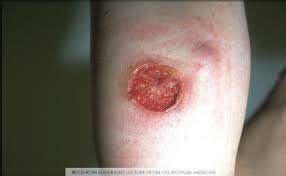
- single or multiple painless nodules occurs following bite which enlarge and ulcerate with characteristic erythematous raised border
- Giemsa stain on a split skin smear demonstrate leishmania parasite in 80% cases
- small lesions require no treatment, large lesion can be treated by topical antiparasite agents


Mucocutaneous leishmaniasis
- caused by L.braziliensis
- cutaneous sore are followed months or years later by indurated or ulcerating lesions affecting mucosa or cartilage, typically on lips or nose (espundia)
- treatment: amphotericin B


Typhoid fever

- caused by Salmonella typhi
- presented with stepladder fever, headache, bodyache, constipation followed by diarrhea
- Rose spot on the trunk towards end of first week
- Relative bradycardia
- Leukopenia is a feature. Widal test or Typhidot test can establish the diagnosis.
- Complications: bowel perforation, meningitis, myocarditis, acalculous cholecystitis
- Treatment: Ceftriaxone

Rabies

- caused by Lyssavirus
- transmission through bite of an infected animal
- established infection is invariably fatal (only 6 recorded cases of survival)
- hydrophobia is due to severe pharyngeal spasms on attempting to eat or drink
- aerophobia is considered pathognomonic of rabies
- post-mortem: classic Negri bodies

CMV retinitis

- without HAART, up to 30% of AIDS patients develop reactivation of CMV in the form of destructive and blinding retinitis
- slowly progressive disorder, visual loss may occur suddenly as a result of hemorrhage or retinal detachment
- presents with blurring of vision, scotoma, floaters and flashing lights
- patches of irregular retinal pallor and hemorrhage in perivascular distribution
- complications: retinal detachment, branch retinal artery occlusion, persistent iritis, cataract
- treatment: IV ganciclovir 10mg/kg/day for 3 weeks, foscarnet
 (ganciclovir is myelosuppressive, FBC should be monitored)

Thursday, 6 October 2011

Felty's syndrome

mnemonic : "SANTA"

S: Splenomegaly
A: Anemia
N: Neutropenia
T: Thrombocytopenia
A: Arthritis (Rheumatoid)

- up to 3% of RA patients have Felty's syndrome
- 90% patients with Felty's syndrome are HLA DRW4

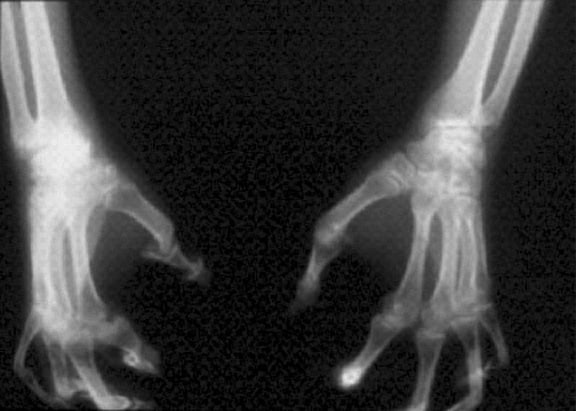
Arthritis mutilans

- rare form of psoriatic arthritis, found in 1-5% of patients
- resorption of bone (osteolysis) with dissolution of joint
- redundant overlying skin with a telescoping motion of joint
- X-ray: pencil-in-cup
- treatment: methotrexate