Total Pageviews

Sunday, 6 November 2011

Maturity onset diabetes of young (MODY)

- monogenic diabetes mellitus
- early onset of diabetes with strong family history, often easy to control
- autosomal dominant
- MODY 3 (mutation of HNF-1a) is the commonest (70%), sensitive to treatment with sulphonylureas, raised HDL, preserved insulin sensitivity and glycosuria
- MODY 2 (mutation in glucokinase), usually asymptomatic and does not need treatment, but important to identify as it can lead to reduced birthweight in pregnancy
- MODY 1 (mutation of HNF-4a), presents later in life
- MODY 5 (mutation of HNF-1b), leads to renal cyst and proteinuria
- MODY 4 (IPF-1 mutation) and MODY 6 (NeuroD1 mutation) are rare

*HNF = hepatic nuclear factor
  IPF = insulin promoter factor

Cryoglobulinemia

- cryoglobulins are immunoglobulins and complement components which precipitate reversibly in cold, which leads to small vessel damage and deposition on the wall of small vessel result in generalised vasculitis
- presents with purpura, arthralgia, leg ulcers, Raynaud's phenomenon, polyneuropathy, asymptomatic proteinuria, microscopic hematuria or nephrotic syndrome
- skin most commonly involved (>90%) - reticulated skin pattern of microthrombosis and areas of gangrene
- management : plasma exchange, high dose steroid, chemotherapy (cyclophosphamide) and treatment of underlying conditions
- 3 types are recognised

Type I
- monoclonal antibody (usually IgM)
- associated with multiple myeloma and lymphoproliferative disorder
- presents with acrocyanosis, Raynaud's phenomenon, retinal hemorrhage

Type II & III (mixed cryoglobulinemia)
- IgM or IgA with rheumatoid factor activity binds to polyclonal IgG
- type II is monoclonal ; whereas type III is polyclonal
- presents with glomerulonephritis (more common in type II), vasculitic rash and Raynaud's
- they can activate the classical pathway of complement and cause consumption therefore low C4 with normal C3
- associations: Hepatitis B and C, HIV, CMV, malaria, EBV, malaria, autoimmune disorder
  * Meltzer's triad =  Purpura + Arthralgia + Myalgia *
     (Typically seen in polyclonal CG - hepatitis C)

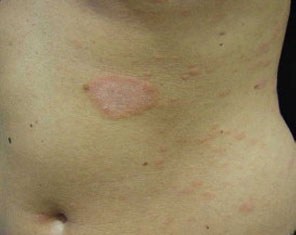
Pityriasis rosea

File:Pityriasisfront.jpg

- self limiting rash commonly seen in adolescent or young adults
- thought to be viral or post-viral rash. Not caused by fungus
- begins as large single pink patch on trunk (Herald patch) followed by generalised body rash lasting for 6 weeks.
- No treatment is required. 1% menthol in aqueous cream may relieve any itch

Saturday, 5 November 2011

Lead poisoning

- occurs occupationally, pica, lead containing cosmetics or drugs
- presents with lethargy, abdominal pain, vomiting, constipation and encephalopathy
- typically results in peripheral motor neuropathy
- bluish discoloration of gum margins (deposition of lead sulphide) - Burton line
- basophilic stippling (due to aggregate of RNA in immature red cells owing to inhibition of pyrimidine-5-nucleotidase)
- investigation : blood lead level
- cause proximal RTA / Fanconi syndrome
- treatment: chelation with IV sodium calcium edetate or oral DMSA

Suicide risk

SADPERSONS

S - sex
A - age
D - depression
P - previous attempt
E - ethanol abuse
R - rational thinking loss
S - social support lacking
O - organised plans
N - no spouse
S - sickness

Creutzfeldt Jakob disease (CJD)

- human prion disease
- prions are glycoproteins which codes for a membrane protein
- definitive diagnosis is post mortem neuropathological examination
- tonsillar biopsy and CSF 14-3-3 (marker of rapid neuronal destruction) helps in diagnosis


New variant CJD
- young adults (mean age 29) presents with painful sensory symptoms, psychiatric symptoms, ataxia, dementia, myoclonus, upgaze paresis and chorea
- MRI : high signal on T2 weighted image in pulvinar (posterior thalamus)
- EEG normal


Sporadic CJD
- older age, shorter disease duration
- rapidly progressive dementia, cerebellar ataxia, pyramidal and extrapyramidal signs and myoclonus
- EEG : triphasic waves

Friday, 4 November 2011

Cutaneous larva migrans

- caused by larvae of hookworm Ancylostoma braziliense which penetrate skin
- serpiginous, itchy rash
- treatment: 15% solution of topical tiabendazole

Granuloma inguinale

- a.k.a donovanosis
- caused by Klebsiella granulomatis, encapsulated gram negative bacillus
- mode of transmission: sexual contact
- characteristic heaped up ulcerating lesion with prolific red granulation tissue
- rarely painful
- extension of primary infection to inguinal regions produces pseudo-bubo
- donovan bodies can be identified intracellularly in scrapings or biopsies of an ulcer
- treatment: doxycycline, bactrim or azithromycin

Thursday, 3 November 2011

Minerals deficiency

Zinc deficiency
- acrodermatitis enteropathica is an inherited disorder caused by malabsorption of zinc
- causes dermatitis, growth retardation, severe diarrhea, alopecia, poor wound healing and impaired taste and smell

Selenium deficiency
- rare, except in Keshan (Chine) where soil has low selenium conteny
- causes cardiomyopathy

Copper deficiency
- Menkes' kinky hair syndrome is caused by malabsorption of copper
- causes anemia, growth failure, mental retardation, brittle hair

Heparin induced thrombocytopenia

- usually occurs 5-14 days after first heparin exposure
- due to immune response directed against heparin/platelet factor 4 complexes
- paradoxially associated with severe thrombosis (most commonly DVT)
- thrombosis results from IgG-induced platelet activation (via platelet Fc receptor) which leads to generation of procoagulant, platelet derived microparticles.
- Type 1 HIT (non-immune) presents with first 2 days after exposure, platelet count normalised with continued heparin therapy (rarely falls below 100 X 10^9/L in type 1). Type 2 HIT (immune mediated) is the serious type with thrombotic complications.
- presence of anti-PF4-heparin antibodies
- alternative anticoagulation: heparinoid danaparoid or direct thrombin inhibitor hirudin
   (avoid warfarin - risk of warfarin necrosis)