Total Pageviews

Friday, 4 November 2011

Granuloma inguinale

- a.k.a donovanosis
- caused by Klebsiella granulomatis, encapsulated gram negative bacillus
- mode of transmission: sexual contact
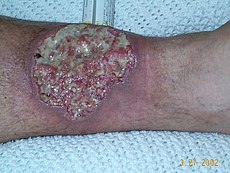
- characteristic heaped up ulcerating lesion with prolific red granulation tissue
- rarely painful
- extension of primary infection to inguinal regions produces pseudo-bubo
- donovan bodies can be identified intracellularly in scrapings or biopsies of an ulcer
- treatment: doxycycline, bactrim or azithromycin

Thursday, 3 November 2011

Minerals deficiency

Zinc deficiency
- acrodermatitis enteropathica is an inherited disorder caused by malabsorption of zinc
- causes dermatitis, growth retardation, severe diarrhea, alopecia, poor wound healing and impaired taste and smell

Selenium deficiency
- rare, except in Keshan (Chine) where soil has low selenium conteny
- causes cardiomyopathy

Copper deficiency
- Menkes' kinky hair syndrome is caused by malabsorption of copper
- causes anemia, growth failure, mental retardation, brittle hair

Heparin induced thrombocytopenia

- usually occurs 5-14 days after first heparin exposure
- due to immune response directed against heparin/platelet factor 4 complexes
- paradoxially associated with severe thrombosis (most commonly DVT)
- thrombosis results from IgG-induced platelet activation (via platelet Fc receptor) which leads to generation of procoagulant, platelet derived microparticles.
- Type 1 HIT (non-immune) presents with first 2 days after exposure, platelet count normalised with continued heparin therapy (rarely falls below 100 X 10^9/L in type 1). Type 2 HIT (immune mediated) is the serious type with thrombotic complications.
- presence of anti-PF4-heparin antibodies
- alternative anticoagulation: heparinoid danaparoid or direct thrombin inhibitor hirudin
   (avoid warfarin - risk of warfarin necrosis)

Ciclosporin


- calcineurin inhibitor
- inhibit calcium dependent second messenger signals in T cells following activation via TCR
- inhibits IL-2 production by T-lymphocytes
- adverse effects (4HRT)
  H - hyperkalemia, hypertension, hypertrichosis, hypertrophy of gum
  R - renal toxicity (chronic interstitial nephritis)
  T - tremor

Glucagonoma


- rare alpha cell tumor
- 90% associated with skin rash (necrolytic migratory erythema)
- 70% are malignant, metastasis are common at presentation
- treatment: combination chemotherapy (streptazocin and 5-FU)

Morphoea


- localised scleroderma characterised by firm, white, violaceous patch of skin which usually occurs on thigh, trunk or arms
- begins as erythematous or flesh-colored plaques that become sclerotic, develop central hypopigmentation and demonstrate an erythematous border
- localised morphea (one or a few lesions); generalised morphea (widespread cutaneous lesion without systemic involvement)
- physical therapy to prevent joint contracture and to maintain function
- usually resistant to therapy

Pyoderma gangrenosum

- erythematous nodules or pustules which frequently ulcerate
- typical bluish black undermined edge and a purulent surface
- biopsy: intense neutrophilic infiltrate
- causes: inflammatory bowel disease (UC > Crohn's) , RA, myeloma, leukemia, lymphoma, PBC
- treatment: potent topical steroid, tacrolimus ointment

Lichen planus

- pruritic inflammatory dermatosis commonly associated with mucosal involvement
- associated with autoimmune diseases
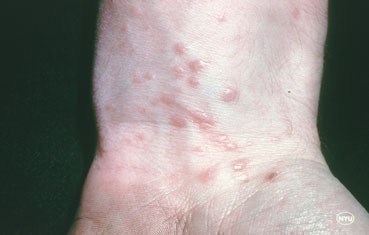
- rash is characterised by small, purple flat-topped, polygonal papules that are intensely pruritic
- common on flexor of wrist and lower legs
- genitalia can be affected
- fine lacy white pattern on surface of lesion (Wickham's striae)
- exhibit Koebner phenomenon
- treatment: topical steroid or topical tacrolimus ointment for painful mucosa disease

Diphtheria

- caused by Corynebacterium diphtheriae (Gram positive bacillus)
- produces a toxin which affects myocardium, nervous and adrenal tissues
- most common presentation is with pharyngitis
- areas of grey or white fibrinous exudate coalesce to produce a tough grey-yellow membrane that bleeds when removed (pseudomembrane)
- regional lymphadenopathy produces "bull-neck"
- cutaneous diphtheria may occur, typically ulcer is punched-out with undermined edges covered with a greyish white to brownish adherent membrane
- neuritis frequently follows bulbar distribution
- treatment: anti-toxin (risk of anaphylaxis) and benzylpenicillin 1.2gm QID for 1 week

Wednesday, 2 November 2011

Erythroderma


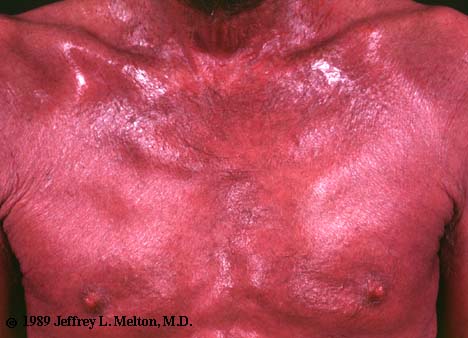
- inflammatory skin disease with erythema and scaling that affects nearly entire cutaneous surface
- a.k.a exfoliative dermatitis
- most commonly due to eczema, followed by psoriasis, lymphoma/leukemia, drug (sulphonamide, gold, penicillin, allopurinol)
- complications: hypothermia, fluid loss, capillary leak syndrome, high output cardiac failure
- treatment: emollients and fluid replacement, oral methotraxate for erythrodermic psoriasis