Total Pageviews

Tuesday, 6 September 2011

Botulism


- presynaptic neuromuscular junction disorder caused by anaerobic Clostridium botulinum
- transmitted through food contaminated with toxin / IVDU
- blocks release of acetylcholine from motor nerve terminal
- incubation period from 4-14days
- 2 forms: food borne or wound botulism
- presents with cranial neuropathies, autonomic dysfunction (dry mouth, urinary retention), descending limb weakness and depressed reflexes
- NO sensory signs
- respiratory failure is a common complication
- diagnosis: demonstrate toxins in serum, stool or vomitus
- edrophonium test false positive in 1/3 cases
- repetitive nerve stimulation: progressive increase in amplitude of potentials
- treatment: supportive, Botulinum antitoxin (trivalent antiserum), guanidine hydrochloride, penicillin and metronidazole

Monday, 5 September 2011

Hereditary hypokalemic tubulopathies

Things to remember for Bartter's , Gitelman's & Liddle's syndrome

- all present with hypokalemia + metabolic alkalosis
- Liddle's syndrome is autosomal dominant and associated with hypertension while the other two are recessive and normotensive. It is caused by mutation of epithelial sodium channel, thus hypertension is very sensitive to diuretics which target on ENaC (amiloride, triamterene)
- Bartter's syndrome is associated with increased urine calcium, and juxtaglomerular apparatus hyperplasia, associated with renal stone and nephrocalcinosis. Secondary hyperaldosteronism is characteristic (plasma volume is low despite normal blood pressure, thus stimulate renin release)
- Gitelman's syndrome is associated with low urine calcium and hypomagnesemia. Treatment is potassium and magnesium supplements.

Sunday, 4 September 2011

Churg-Strauss syndrome

- eosinophilic granulomatous inflammation of respiratory tract with small and medium vessels necrotizing vasculitis
- pANCA is positive (50%)
- leukotriene inhibitor allow steroid doses to be lowered and this may unmask underlying vasculitis
- causing focal segmental glomerulonephritis
- principle cause of morbidity and mortality are myocarditis and myocardial infarction secondary to coronary arteritis
- serum IgE is commonly elevated and correlates with disease severity
- treatment: glucocorticoids, azathioprine, cyclophosphamide
- with treatment, 1 year survival is 90% and 5 year survival is 62%

mnemonic : BEAN SAP


BE: Blood Eosinophilia
A  : Asthma
N  : Neuropathy (mononeuritis multiplex) - usually common peroneal nerve
S  :  Sinus abnormality
A  : Allergies
P  : Perivascular eosinophils / vasculitis

juvenile myoclonic epilepsy

- most common primary generalised epilepsy
- genetically linked to short arm of chromosome 6
- absence seizure during childhood
- in adolescent, presents with myoclonic jerks in the morning after waking (Kellogg's jerk) and generalised tonic clonic seizure.
- worsened by sleep deprivation and alcohol
- EEG: generalised spike and polyspike wave activity
- treatment: valproate (extremely respond well) and lamotrigine (lower rate of drug interaction)
- lifelong drug treatment is usually necessary to avoid relapse in patients who achieve seizure free status on medication

Lambert-Eaton syndrome

- autoimmune disorder caused by antibodies against the voltage-sensitive calcium channels of the motor nerve terminals
- males more than female, with underlying malignancy (majority small lung lung CA)
- typically presents with weakness improved with exercise
- reduced/absent reflex (cardinal sign), because less transmitter is released, but reflexes may increase after maximum voluntary contraction (post-tetanic potentiation)
- also presents with autonomic symptoms (dry mouth)
- nerve conduction studies: compound motor action potential have small amplitude which after exercise or with repetitive stimulation will immediately increase by 100%
- voltage gated calcium channel antibodies are seen in almost 100% of LEMS patient with cancer and 90% of LEMS patient without cancer
- treatment: 3-4 diaminopyridine 20mg 5 times/day (potassium channel blocker, which helps maintain depolarisation of the nerve terminal by preventing repolarisation, leading to more calcium enter nerve terminal) or IVIG
 

Cystinuria

- autosomal recessive
- defective tubular reabsorption and jejunal absorption of cysteine and dibasic amino acids (COAL - cysteine, ornithine, arginine, lysine)
- commonest cause of renal stone in children where a metabolic cause is identified
- presents with chronic backache, recurrent urinary stones
- cysteine is highly insoluble at acid pH and form radio-opaque calculi
- urine FEME: pathognomonic hexagonal crystal

- management: large fluid intake, alkalinisation of urine and penicillamine / tiopronin /captopril

Polymyalgia rheumatica

- inflammatory soft tissue condition characterised by persistent pain and stiffness of neck, shoulder girdle and pelvic girdle
- female aged more than 50 years
- proximal muscle pain (shoulder or pelvic) without weakness + early morning stiffness
- Lab findings: raised ESR(more than 40), raised CRP, abnormal LFT (ALP,GGT), anemia
- Response to corticosteroid is dramatic and prompt (within 24-72 hours). Optimal starting dose is 15mg od for first month.
- The risk of relapse is higher with smaller dose and risk of adverse event increased with larger dose.
- Initial dose reduction should be 2.5mg fortnightly until 10mg daily and reduce 1mg each 6 weeks until 5-7mg daily. Maintenance dose 5-7mg daily for 12 months provided symptoms controlled. Subsequently prednisolone can be reduced by 1mg every 6-8 weeks.

hereditary angioedema

- autosomal dominant
- mutation at C1 inhibitor gene, causing low levels of C1 esterase inhibitor
- painless, non pruritic, non pitting swelling of skin
- characterised by recurrent self limited attacks involving skin, subcutaneous tissue, upper respiratory tract, gastrointestinal tract
- reduced C1, C2 and C4 levels (reduced C4 level even between attacks), normal C3
- treatment: C1 esterase inhibitor concentrates 1000-1500 unit IV over 20-30mins, danazole (induce liver enzymes to synthesize C1 esterase inhibitor), fresh frozen plasma (potential to aggravate the condition as it replaces all the complement components, not just C1 inhibitor)

Saturday, 3 September 2011

Fragile X syndrome

- a.k.a Martin-Bell syndrome
- X-linked recessive
- trinucleotide repeat disorder (in FMR 1 gene)   - genetic anticipation
- most common cause of inherited intellectual disability
- second most common known cause of mental retardation in males
- expansion of CGG on X-chromosome

  • 6-55 : normal
  • 55-230 : premutation carrier
  • 230->1000 : disease state / full mutation
- features: elongated face, prognathism, macroorchidism, large low set floppy ear, short stature, hyperflexible joints, high arched palate, ADHD, autism

File:Fragile x syndrom.png

G6PD deficiency

- X-linked recessive
- G6PD oxidises glucose-6-phosphate to 6-phosphogluconolactone with reduction of NADP to NADPH. Thus G6PD is to protect red cell from oxidative damage
- On exposure to infection, fava beans, certain drugs, patient will develop intravascular hemolysis with hemoglobinuria
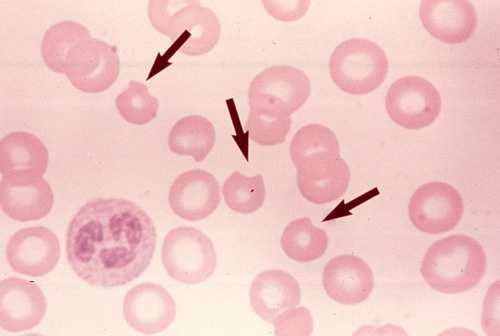
- Blood film : bite cells (degmacytes), blister cells with Heinz bodies (oxidized denature hemoglobin) removed by spleen
- Treatment: stop the offending drug, maintain a high urine output and transfuse if necessary